
Share This Article
DEVELOPMENT
Umpire Journal: A Better Way to Improve After Every Game
Track your calls, mechanics, game management, and progress one game at a time.
If you want to become a better umpire, one of the simplest habits you can build is keeping an umpire journal.
A good umpire journal gives you a place to review difficult calls, mechanics, positioning, game management, partner communication, rules situations, and the things you want to improve before your next assignment.
Some of the best lessons in umpiring happen after the final out. That’s when you can look back honestly at what went right, what could have gone better, and what you want to carry into your next game.
You don’t need to write pages after every assignment. A few focused notes can help you spot patterns, track your progress, and keep valuable lessons from disappearing into memory.
Over time, those notes become more than a game log.
They become a roadmap for becoming a better umpire.
Why Keeping an Umpire Journal Makes You Better
The best umpires are always learning.
Every game gives you something to work with. Maybe it’s a difficult call, a positioning mistake, a rules situation you weren’t completely sure about, or a conversation with a coach that you could have handled differently.
The problem is that those lessons disappear quickly if you don’t capture them.
That’s where an umpire journal becomes valuable.
Instead of relying on memory, you create a record of what actually happened and what you learned from it.
Over time, your journal can help you:
- Spot recurring mistakes. If the same positioning problem keeps appearing in your notes, you know exactly what needs attention.
- Track your improvement. You can see how your mechanics, confidence, communication, and game management change throughout the season.
- Prepare for future games. Notes about fields, weather, partners, or unusual situations can help you walk into your next assignment better prepared.
- Strengthen your rules knowledge. When an unusual play happens, record it, look up the rule afterward, and add what you learned.
- Build confidence. Your journal shouldn’t only record mistakes. It should remind you of the tough calls you got right and the difficult situations you handled well.
Preparation is a huge part of consistency. A journal works even better when it becomes part of a repeatable game-day routine. If you haven’t already built one, start with Why Every Ump Needs a Game-Day Checklist.
Think of your journal as your own personal umpire development record.
Game by game, you’re building a picture of what kind of umpire you are becoming.
When Should You Write in Your Umpire Journal?
The best time to write in your umpire journal is right after the game, while the details are still fresh.
That’s when you’ll remember the pitch you weren’t sure about, the rotation that broke down, the coach conversation that could have gone better, or the play where you were in exactly the right position.
Wait until the next day and some of those details start to disappear.
A simple routine works best:
- Before the game: Make a few optional notes about the field, weather, level of play, crew, or anything you want to focus on.
- Immediately after the game: Record the important calls, situations, mechanics, interactions, and your overall performance.
- At the end of the week: Look back at several games and see if the same strengths or problems keep showing up.
- Monthly or seasonally: Review your entries to see how your umpiring is developing over time.
You don’t need to spend 30 minutes writing after every assignment.
Even five focused minutes can give you something useful to carry into your next game.
The key is consistency.
Make it part of your postgame routine, just like cleaning your gear, checking your next assignment, and getting ready for the next time you step onto the field.
What to Record After Every Game
Your umpire journal does not need to capture every detail of every inning.
What matters is recording the things that can help you improve.
A good postgame entry should answer a few basic questions:
What happened? How did you handle it? What did you learn? What do you want to do better next time?
1. Game Details and Conditions
Start with the basics so you can put the rest of the entry in context later.
Record things like:
- Date and time
- Field or location
- Level of play
- Teams
- Final score
- Position worked
- Partner or crew
- Weather
- Field conditions
- Lighting
- Any gear worth noting
You do not need to document every piece of equipment unless something was different or affected your performance.
These details may seem minor, but they can be surprisingly useful later. You may discover that certain fields, weather conditions, or levels of play create the same challenges again and again.
Weather can also directly affect how well you work a game. If heat, cold, rain, or wind becomes a recurring issue in your notes, review your Umpiring in Extreme Weather resources and make adjustments before your next assignment.
2. Calls, Mechanics, and Positioning
This is one of the most important parts of your journal.
Think back through the plays that made you work.
Record:
- Tough calls you got right
- Calls you were unsure about
- Plays you think you missed
- Angles that worked well
- Times you were straight-lined
- Rotations that felt late
- Plate mechanics that felt good or uncomfortable
- Positioning you want to improve
Be specific.
Instead of writing:
“Bad call at first.”
Write:
“Possible pulled foot at first. I stayed too narrow coming up the line and didn’t have a clean look at the foot and bag. Next time I need to work for a wider angle earlier.”
That gives you something you can actually use.
If something as simple as losing track of the count ever appears in your notes, take another look at How Do Umpires Keep Track of Balls and Strikes? Small habits with your indicator can prevent larger concentration problems later in the game.
3. Rules and Unusual Situations
Every umpire eventually runs into plays that make you think:
“I need to look that one up.”
Write them down.
Examples might include:
- Interference
- Obstruction
- Balks
- Appeals
- Dropped third strikes
- Runner responsibilities
- Unusual substitutions
- Rule differences between organizations
- Crew consultations
After the game, verify the rule and add the correct interpretation to your notes.
Do not rely on what somebody in the parking lot says the rule is. Go back to the rulebook or a reliable official source.
Little League umpires can use the Little League Umpire Training Materials for mechanics, training, rules instruction, and other umpire resources.
If you work high school baseball, the NFHS Baseball Resources page provides rules interpretations, umpire signals, points of emphasis, and other official material.
This becomes especially important if you work under several different rule codes.
Baseball does not have one universal rulebook. If you bounce between Little League, travel baseball, high school, college, or other organizations, review Not All Baseball Rules Are the Same: Here’s What You Need to Know.
Your journal is a great place to record those differences before they trip you up in a game.
4. Game Management and Communication
Not every important umpire moment involves a call.
Sometimes the biggest lesson comes from how you handled a coach, player, partner, or difficult situation.
Record things like:
- Coach conversations
- Warnings
- Ejections
- Player behavior
- Crew communication
- Pregame effectiveness
- Rotations or responsibilities that broke down
- Situations where you stayed calm
- Situations where you could have communicated better
Keep the notes factual.
Instead of:
“Coach was a jerk all night.”
Write:
“Coach questioned the strike zone several times during innings three through five. Warning issued in the sixth. No further issues.”
That kind of note helps you evaluate your game management instead of simply reliving your frustration.
If conflict with coaches or players keeps appearing in your journal, spend some time reviewing Umpire Conflict Response: The Definitive Guide to Staying Calm When the Game Gets Heated.
Partner communication deserves the same attention.
A good crew starts working together before the first pitch. Use your journal to identify things that should become part of your next Umpire to Umpire Pre-Game Conference, especially rotations, responsibilities, communication, and unusual field conditions.
5. Your Takeaway for the Next Game
Every journal entry should end with one clear takeaway.
Ask yourself:
What is one thing I want to carry into my next game?
It might be something you want to improve:
“I need to move earlier on plays at first instead of reacting after the throw.”
Or something you want to continue:
“Keeping my head still behind the plate gave me a much more consistent look at the strike zone tonight.”
You can also record one thing you were proud of.
That matters.
Your umpire journal should not become a running list of mistakes. It should also remind you of the difficult calls you nailed, the games you controlled well, and the progress you are making.
The goal is not to prove that you were perfect.
The goal is to make sure every game teaches you something.
How to Turn Your Journal Into an Umpire Development Tool
Writing after each game is useful.
Reviewing those notes over time is where the real value starts to show up.
One entry might tell you that you struggled with a rotation. Five or ten entries might show you that the same problem keeps happening in similar situations.
That’s the kind of pattern you want to find.
Review Your Entries Regularly
Every few weeks, go back through your journal and look for recurring themes.
Ask yourself:
- Am I struggling with the same type of call?
- Do I keep getting caught in the same bad angle?
- Is my plate work becoming more consistent?
- Am I handling coaches better?
- Are certain rule situations giving me trouble?
- Is my confidence improving?
- Are my mechanics becoming more natural?
You may notice things that were impossible to see while working individual games.
That’s why the journal becomes more valuable the longer you use it.
Track Specific Areas of Improvement
If you already know you’re working on something, make it easy to find later.
For example, you might track:
- Plate mechanics
- Timing
- Positioning
- Balks
- Interference
- Obstruction
- Game management
- Crew communication
- Weather delays
- Difficult coaches
If you use a digital journal, tags can make this simple.
Examples might include:
#plate
#mechanics
#gamecontrol
#balk
#positioning
#weatherdelay
After a few months, you can search one topic and see how often it came up and whether you improved.
Add Supporting Material
Your journal does not have to stand alone.
You can also save or reference things like:
- Game assignments
- Rulebook notes
- Evaluations
- Training notes
- Photos
- Video clips
- Tournament information
- Weather conditions
If you have access to video from one of your games, use it.
Your memory of a play and what actually happened on the field are not always the same thing.
Video gives you the chance to compare what you thought you saw with your actual positioning, timing, and mechanics. The camera does not lie.
That kind of review can be uncomfortable sometimes.
Do it anyway.
That is how you improve.
Use Your Journal to Prepare for Future Games
Your old notes can also become part of your preparation.
Before working a tournament, returning to a difficult field, or stepping into a higher level of baseball, review anything relevant from the past.
You may find reminders about:
- Field conditions
- Crew tendencies
- Previous rules situations
- Communication issues
- Areas you were working on
- Things that helped you succeed
That turns the journal into more than a history of your games.
It becomes a reference tool.
Connect Your Notes to Your Long-Term Goals
If you want to move into better assignments, tournaments, or championship games, your journal can help you see whether your development is actually moving forward.
Track what evaluators tell you.
Write down what experienced umpires teach you.
Pay attention to what keeps showing up in your own self-assessment.
Then work on it.
Advancement usually comes from consistent improvement over time, not one great game.
If one of your long-term goals is tournament advancement, your journal can become part of the development process that prepares you for bigger assignments, including the path toward becoming a Little League World Series umpire.
Your journal cannot get you the assignment.
But it can help you become the umpire who is ready when an opportunity comes.
Your Next Game Is the Starting Point
Keeping an umpire journal is not complicated, and it does not need to become another chore.
You do not need perfect handwriting, a fancy notebook, or a detailed entry after every inning.
You just need to pay attention, be honest with yourself, and write down the things that can help you improve.
Some games will give you one useful takeaway.
Other games will give you a full page.
Both matter.
Over time, those notes start to tell a story.
You’ll see where your mechanics improved, where your confidence grew, which situations kept giving you trouble, and which habits helped you become more consistent.
That is the real value of an umpire journal.
It gives you a way to learn from your own experience instead of depending on memory alone.
So after your next game, take five minutes.
Write down what went well.
Be honest about what did not.
Then decide what you want to do better next time.
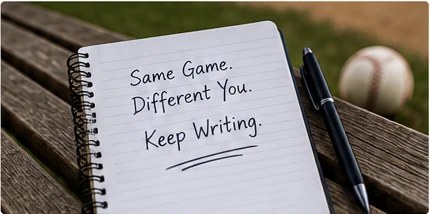
One game. One entry. One lesson at a time.
Free Umpire Game Log Template
Download our free game log and start tracking your progress after every game.
Featured Umpire Journal

100% Every Pitch Every Play
A simple pen-and-paper option for recording postgame notes, reviewing calls, and tracking your development throughout the season.
Affiliate Disclosure: As an Amazon Associate I earn from qualifying purchases. I may earn a commission when you purchase through links on this page, at no additional cost to you.
Related Articles
Extreme Weather Umpire Gear Guide: Stay Cool, Stay Warm
Umpiring in Extreme Weather: How to Stay Sharp in Heat, Cold, Rain, and Wind
How to Keep Your Umpire Game Schedule Organized

Umpire to Umpire Pre-Game Conference
Choosing the Right Umpire Journal
There’s no single journal that works for every umpire.
Some umpires prefer pen and paper. Others want everything stored digitally so they can search old notes, add photos, or keep rule references in one place.
The important thing is choosing a system you’ll actually use.
Personally, I prefer pen and paper. I use the 100% Every Pitch Every Play Journal, and I keep it in my gear bag so I can make notes shortly after the game.
Call me old school, but writing things down works better for me than trying to remember everything later.